
This story was originally published in the Peterborough Local History Society magazine (Volume 65, October 2025).
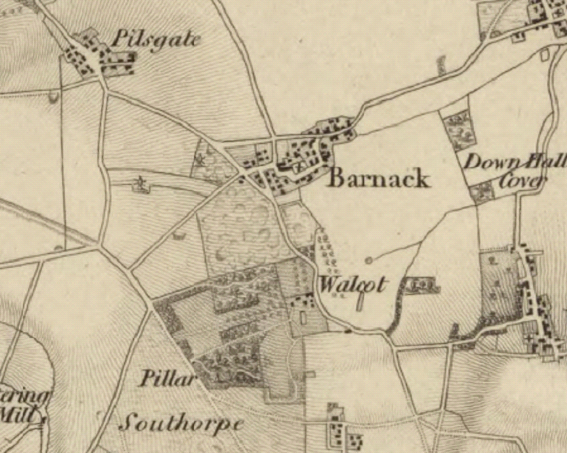
On 19th November 1830, a curious story appeared in the Stamford Mercury. A stonemason had built his own house at Barnack’s Hills and Holes, but it was not to last long. Below is the full text of the article. Be warned that it contains some gruesome details. [Italics in the original. Sic throughout.]
‘A singular accident occurred on Saturday se’nnight1 at the ancient village of Barnack, near Stamford, the stone of which parish has furnished the material wherewith some of the finest religious edifices of the kingdom have been constructed,—as the abbey of Bury St. Edmund’s, and several others situate even more remotely from the quarry.—Mr. John Thompson, a mason of the village, conceived the strange notion of making the cone or mound formed by the rubbish thrown up in digging one of the pits in the now exhausted stratum of stone, serve as the centre upon which he could build a dwelling-house for himself; and he actually did in this way raise the wall of a circular tenement, having two doors, through which, when he had completed the dome of his house, he picked down and carried away the rubbish within, and thus left standing the wall or shell, of sufficient capacity to afford two good-sized apartments. Such a mode of building had at least the recommendation of novelty; and Mr. Thompson, on the afternoon of the day above-stated, had a large tea-drinking party in his new abode, as a “house-warming” The weather unfortunately proved very bad; and as the materials used in the building were only rough stone and road mortar (without any timber whatever), the heavy rain penetrated through the arch in the course of the evening, and by disturbing the cement, occasioned the whole to fall in about 8 o’clock! Several of the tea-drinkers had taken alarm when the rain poured in, and opened the doors; through one of which the whole party of sixteen persons providentially escaped with their lives when the dome fell, but several of them were severely hurt, particularly the wife of a cottager named Leighton, who had her scalp so severely lacerated that it hung down over her eyes, and has since been a serious surgical case. Had it not been for the precaution of opening both the doors, all the party would probably have been killed, for the immense weight of materials which fell completely blocked up one of the door-ways.—Mr. Thompson had intended within a few days to take his family into his extraordinary house; and it is perhaps a fortunate accident that has prevented their taking up their residence in it, as the downfall might have occurred at a time of the night when they would have been in bed, and away from the reach of assistance.’2
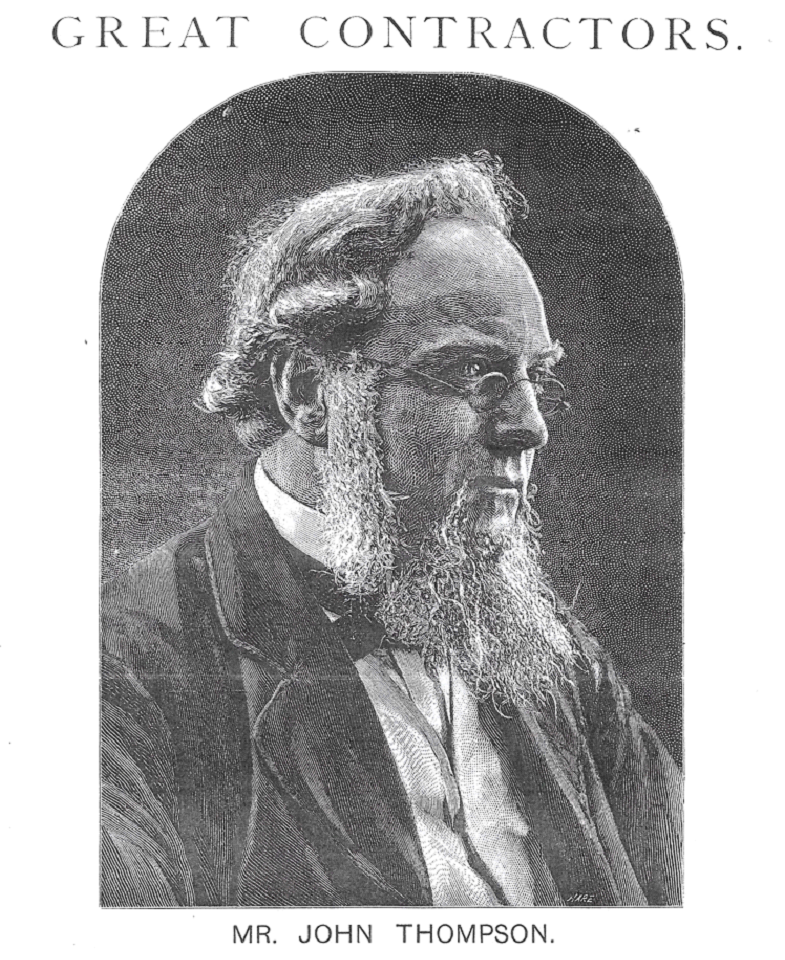
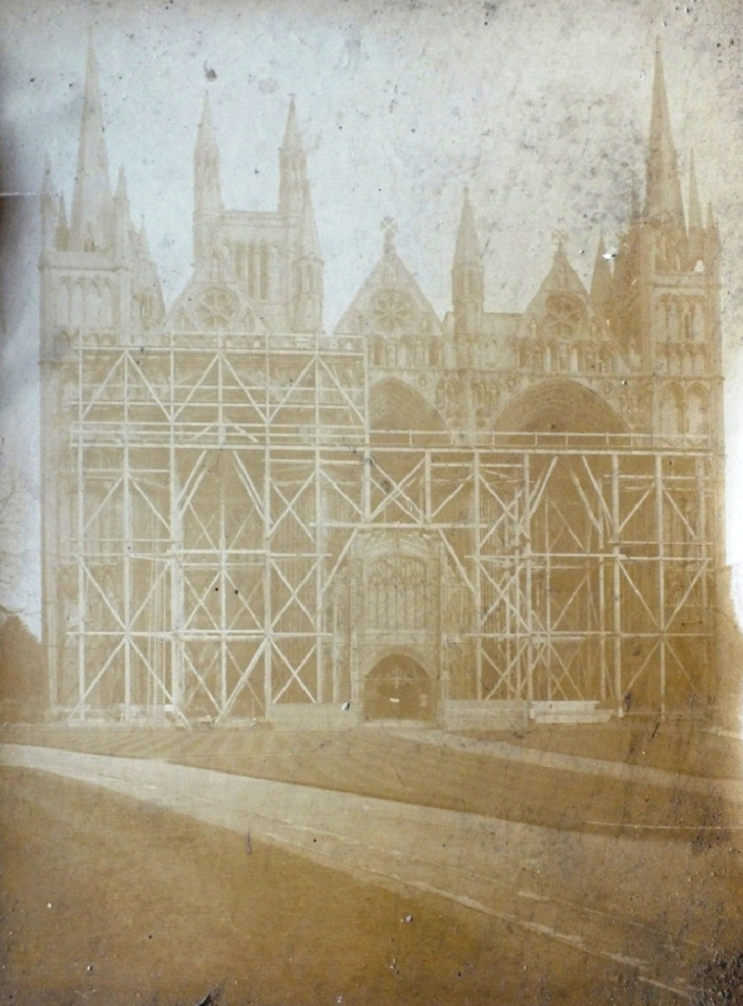
The name John Thompson will be familiar to many. John Thompson, Sr (1787-1853), was a stonemason and master-builder who was born in King’s Cliffe and later moved to the city. He worked with architect Edward Blore and woodcarver Francis Ruddle to renovate the choirs of Peterborough Cathedral and Westminster Abbey, among other projects. His son, John Thompson, Jr (1824-1898), took over the family business upon his father’s death.
John Thompson, Jr, went on to become one of the most accomplished stonemasons of the 19th century,3 building and renovating structures all over the country, including Balliol College at Oxford, Royal Holloway College, and the cathedrals at Peterborough, Hereford, and Chester. He also became an Alderman for Peterborough and was its mayor twice.4 John Thompson, Jr’s sons later took over the business, but the company folded in 1931 as they were building the new Town Hall on Bridge Street.
Could there be a connection between these John Thompsons and the John Thompson of our story? The name is a common one, but there are other reasons to think they were related. John Thompson, Sr, was born in King’s Cliffe but moved to Barnack around four years later in 1791. Several members of the family lived in Barnack, including John Thompson, Sr’s cousin, also called John Thompson (1796-1880). Their grandfather, John Thompson (1725-1777), lived his whole life in Uffington, so the family had a longstanding connection to the area.5
I briefly considered the idea that John Thompson, Sr, might have been our ill-fated builder. From what I had been able to tell, his cousin did not have a wife or children, which would seem to disqualify him. Thompson, Sr, on the other hand, married in 1810 and had moved to Peterborough by 1813 when his daughter Elizabeth was born. Neither of them seemed like a perfect match. The answer would become clear once I had looked through contemporary newspaper coverage.
John Thompson (1796-1880) seems to have been a habitual criminal. He had a series of arrests for theft between 1820 and 1837, and even escaped from jail at one point. Interestingly, he was referred to as a stonemason as early as 1823. One wonders if his cousin might have given him a job in an attempt to get him on the straight and narrow.
The following stories appeared in the local press:
20th October 1820: ‘At the Rutland quarter sessions yesterday, John Thompson, of Barnack, was found guilty of stealing a silver table-spoon, the property of John Redmile, of Ryhall, and sentenced to six months’ imprisonment.’6
5th December 1823: ‘On Monday last, Charles Newborn, of Barnack, gardener,—Newborn Pask, of Ryhall, shoemaker,—and John Thompson, of Pilsgate, mason, were committed to Peterborough gaol, the two former as principals and the latter as accessary (and intended to be a witness for the prosecution) in the stealing of geese from the premises of Mr. Burbidge and Mr. Mean of Ufford… And yesterday Richard Sturgis, of Duddington, poulterer, was convicted before the magistrates of this borough in the penalty of 25l. each for five hares bought by him on Friday last of the above-named John Thompson.’7
12th November 1824: ‘On Wednesday John Thompson [italics], of Pilsgate, near this place, was convicted in the mitigated penalty of ten pounds, for setting snares for game on the Sabbath-day.—In default of payment, he was committed to Peterborough gaol for three months.’8
8th January 1836: ‘Before the Rev. John Hopkinson, chairman, Rev. John James, Rev. J. Boak, and W. Bate, Esq —There was only one case of felony brought before the court, viz. John Thompson, of Barnack, mason, (who, it appeared, had been convicted at Oakham and at Boston of felony,) and George Waite, of Helpstone, labourer, for stealing in the night of the 30th ult. 22 live fowls, the property of Thos. Tomblin, farmer, of Southorpe. Harris, an accomplice, gave evidence for the prosecution. Thompson was sentenced to 18 months’ imprisonment to hard labour, and Waite to 9 months’. It appeared that the latter prisoner was led into the commission of the crime by Thompson, who is his brother in law.’9

29th July 1836: ‘John Thompson, of Barnack, a prisoner in Peterboro’ gaol, who had about eleven months to remain, made his escape last week during the absence of the gaoler (Seaton) at Lincoln assizes. The prisoner effected his escape by pretending that a sink-hole wanted cleaning out, and that the gaoler had ordered him and another prisoner to clean it. He was retaken at Barnack on the 21st inst. and again consigned to gaol.’10
5th May 1837: ‘On Monday last, at a petty sessions held in St. Martin’s, Geo. Wyatt, late ostler at the Horns and Blue Boar public-house, Stamford, was committed for trial at the next Peterboro’ sessions, on the charge of stealing wool (upwards of 40 fleeces) from the premises of Mrs. Eliz Cox, of Maxey.—John Harris, of Maxey, labourer, who has absconded, and John Thompson, late of Barnack, mason, now in gaol for fowl-stealing, it appears were accomplices with Wyatt in stealing the wool.’11
Up until 1844, Peterborough Gaol was in the Minster Yard, meaning Thompson might have been able to admire the cathedral on which his cousin had worked. Perhaps it served as a reminder of his own failings.
To be clear, the crimes listed above were fairly minor. None of them involved any kind of violence, and today we would care little about someone breaking the sabbath. Poaching was commonplace among the poor, and one can imagine that the numerous instances of petty theft were, to some degree, crimes of necessity. In any case, 1837 was the last time his name appeared in print, so we do not know what he did with the rest of his long life.
One last news story reveals that this John Thompson did indeed have a wife:
‘Joseph Jorden, of Stamford, blacksmith, Mary Kingston, of Sheep-street, Northampton, Robert Clarke, of Langtoft, blacksmith, William Warby, of Barnack, mason, Jane the wife of John Thompson, of Barnack, mason, and Wm. Cotterill, of Baston, servant, severally charged with disorderly conduct, after receiving suitable admonitions from the Magistrates were discharged.’12
Thompson’s wife would seem to have been Jane Newborn, as suggested by the names of two of his accomplices. Jane Newborn was born in Barnack in 1797, making her one year younger than Thompson. They married in 1815, at the ages of 18 and 17 respectively, at St. John the Baptist Church in Barnack.13 I have yet to find any record of John and Mary’s children, nor have I found anything about John’s life after 1837, aside from a record of his death in 1880.
Newspapers and official records can only tell us so much about people’s lives, especially if those people were from the lower classes. In their case, they might only make the press when they came into contact with the court system, which means we only see them at their lowest points.
From the scant information we have, we might come to the conclusion that John was foolish and reckless. The house collapse caused serious injury and could have been much worse. If he had been trained as a mason, he must surely have known that the structure was unsafe. We will probably never know what possessed him.
The Thompson family seems to have been much like any other. For all the achievements of John Thompson, Sr, and his descendants, there were other members of the family whose achievements will never be known, and some who likely wished they had that kind of anonymity. The Hills and Holes house collapse must stand as one of the oddest stories from the family’s history.
Thanks go to Andrew Cole, Toby Wood, and Peterborough Archives for their assistance.
- A se’nnight is one week, so this likely refers to 6th November. The Stamford Mercury came out on a Friday, so there is also the chance that it means a week before the following day, ie. 13th November, but in that case, they would probably say, ‘Saturday last.’ ↩︎
- Stamford Mercury, 19th November 1830, p. 3 ↩︎
- ‘The most advisable course for the restoration of a building was once summarily expressed to a novice by saying, “Get hold of Thompson, of Peterborough, for contractor.”’ (‘Great Contractors. Mr. John Thompson’, The Architect, A Business Supplement to the Contract Reporter, vol. xxxix, 10 February 1888, p. 2) ↩︎
- The Peterborough City Council website lists two occasions when Thompson was Mayor: 1881-1882 and 1896-1897 (‘About the Mayor’, 2025, https://www.peterborough.gov.uk/council/the-mayor/about-the-mayor). Oddly, The Building News reported that he had been Mayor four times as of 1890 and three times in his 1898 obituary (‘Contemporary British Builders and Contractors’, The Building News, vol. 58, 4th April 1890, p. 498; ‘Obituary’, The Building News, vol. 74, 5th April 1898, p. 525). ↩︎
- Ancestry.co.uk ↩︎
- Stamford Mercury, 20th October 1820, p. 3 ↩︎
- Stamford Mercury, 5th December 1823, p. 3 ↩︎
- Stamford Mercury, 12th November 1824, p. 3 ↩︎
- Stamford Mercury, 8th January 1836, p. 3 ↩︎
- Stamford Mercury, 29th July 1836, p. 3 ↩︎
- Stamford Mercury, 5th May 1837, p. 3. This offence seems to have been committed in November 1835 according to Stamford Mercury, 26th May 1837, p. 3. ↩︎
- Stamford Mercury, 17th March 1837, p. 3 ↩︎
- ‘Person: Jane Newborn (1)’, werelate.org, last modified 14th September 2011, https://www.werelate.org/wiki/Person:Jane_Newborn_%281%29 ↩︎







Leave a comment