This story was originally published in the Peterborough Local History Society magazine (Volume 63, October 2024). It therefore assumes some knowledge of Peterborough and Stamford in the UK.
CORRECTION: The original version of this article stated that George Chapman set up the Lyceum Theatre in Stamford. The Lyceum was actually set up by another man called John Chapman. It’s not known if the two were related. I have corrected the text and included the original passage in the footnote.
The Spiritualist movement emerged in the 1840s and enjoyed enormous popularity right up to the 1920s. It had no formalised set of beliefs, but its adherents all believed they could contact the spirits of the dead through séances. It was controversial from the beginning, with many Christians denouncing it as a form of witchcraft and sceptics dismissing it as a confidence trick. Despite this, some Spiritualists thought that if their practices were exposed to scientific scrutiny, they would eventually be accepted as genuine.
The typical séance would take place in a darkened room. The medium would sit alone in a box, often with their movements restricted to prevent trickery. Spirits would speak through the medium and often manifested physically. The rise of Spiritualism coincided with that of photography, and many tried to capture these phenomena on film. The results seem rather unconvincing today, either achieved through double exposures or with crude dummies made of wire and cheesecloth.
Séances were held in Peterborough at least as early as the 1870s. In contemporary newspapers, one name turns up more than any other – Robert Catling. Catling was a successful business owner, with a shoe shop on Long Causeway, and was active in the Spiritualist community.
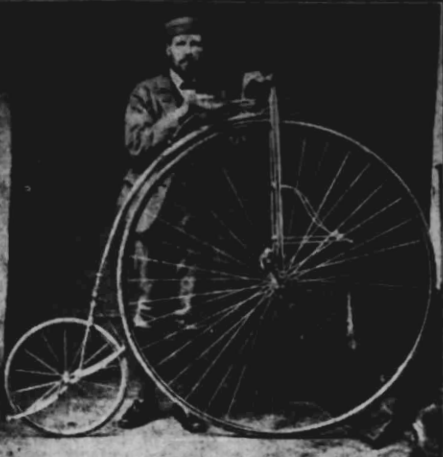
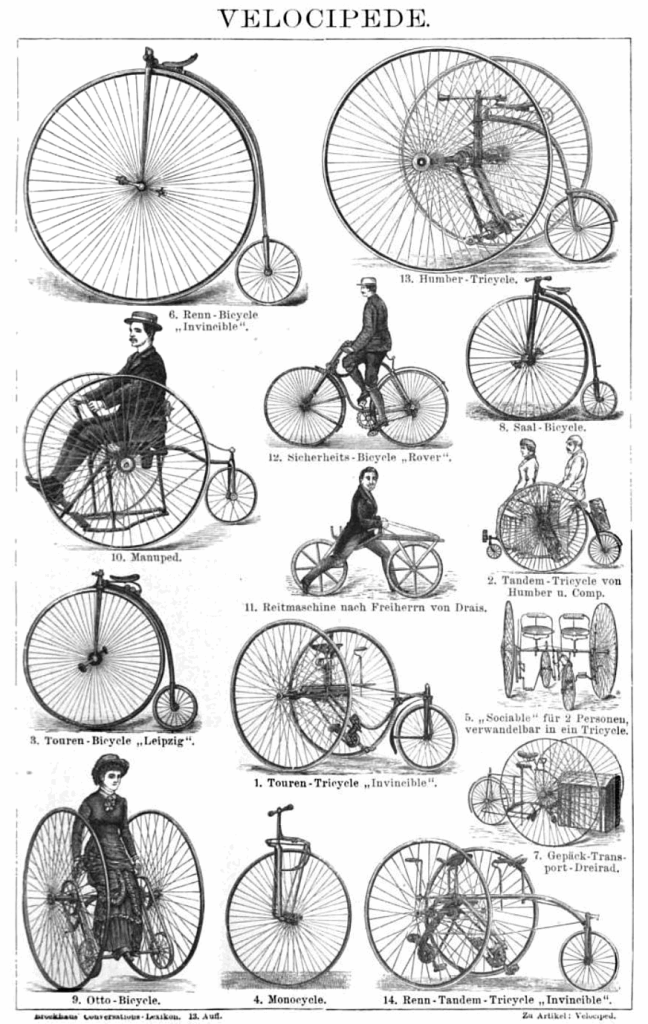
There is scarcely space to go into the details of Robert Catling’s life, but he was also one of the first members of the Peterborough Cycling Club, founded in 1874 and thought to be the oldest continuously active cycling club in the country.1 Cycling and Spiritualism both seem to have been reserved for those with enough time and money. As a testament to Catling’s means, he advertised a tricycle for sale in 1894 for £10, for which he had previously paid £28 (£1,080 and £3,040 in today’s money).2 He also owned at least one bicycle of the Penny Farthing type. There is an account of a cycle race from Eastfield to Thorney and back in 1875 where Catling fell off his bike, having been met with a flock of sheep and a drove of cattle, but later went on to win by a narrow margin.3
The earliest references to séances in Peterborough seem to be from 1874, the same year Catling started advertising meetings at 8pm every Tuesday at his home, 53 Cromwell Road.4 The house was later demolished when Bright Street was extended, but for a time there were plans to build a Spiritualist church there.5 Catling was also involved in events at Whittlesey and Stamford.
One critic in the Peterborough Standard spoke scathingly of the recent trend: ‘We are obliged to the publisher of the “Medium” for sending us a copy of it, inasmuch as it has called our attention to a subject which has lately been exciting considerable interest amongst certain persons in this city and neighbourhood, where classes have been formed for the purpose of practicing spirit communications. Our readers, if they are wise, will not waste their time on such mischievous folly. “Spiritualists,” as the professors of the art delight to call themselves, are divided into two classes—the Dupers and the Duped.’6
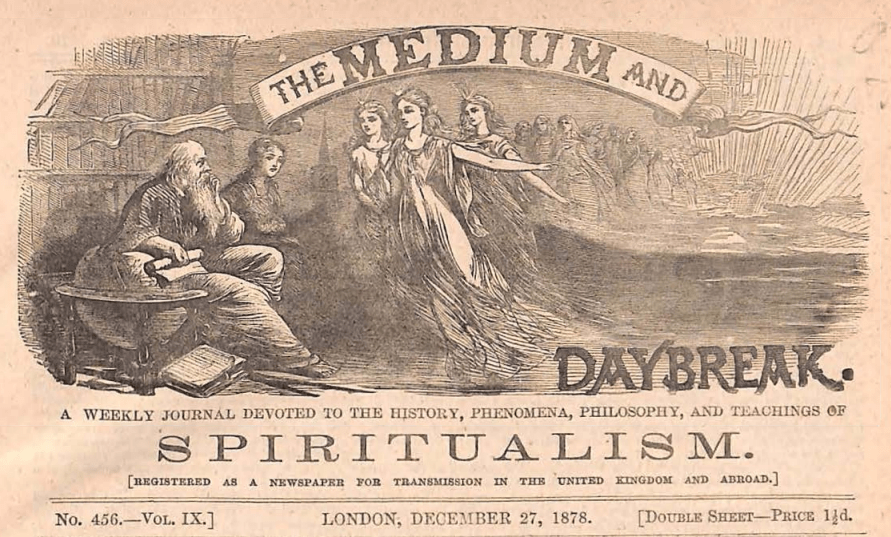
We know the names of some of Catling’s Spiritualist friends, two of whom we will hear from later. There was John T. Markley of Albert Place (between Pets at Home and Asda today), who distributed copies of The Spiritualist to local newspapers7 and promoted the idea of using phrenology in schools,8 Thomas McKinney of London Road, who shared his subscription to at least one Spiritualist newspaper with Catling,9 and Charles Cade of Stamford, a confectioner and auctioneer who later became a sceptic.
One of the mediums at these early meetings was George Chapman, a fellow Peterborian of whom it was said, ‘Let our Peterboro’ friends look well after this medium. He is likely to develop into a star of great magnitude.’10 John Chapman, who may or may not have been related to George, built a small theatre in Stamford called the Lyceum (or Progressive Lyceum) around 1880, where séances were held for some years. Its exact location is uncertain, but it seems to have been in or around the Recreation Ground in Northfields, which was in the process of becoming the town’s first suburb.11 George Chapman’s fame seems to have been short-lived, but there are worse fates than being forgotten.
It is unclear whether Mr. Catling practiced as a medium, but his wife Isabella certainly did. In an article from 1881, Mrs. Catling is reported to have channelled various spirits, as well as seeing symbolic imagery. At one point in the séance, she was visited by ‘two rather ignorant friends—who appeared to the medium as costermongers, fond of a drop of the “creature.” But they found they had got into the wrong box.’12
In 1881, Mrs. Catling summoned the spirit of a Hindu man called Houtad. He was described as wearing ‘tall feathers in his head-gear, which shoot up straight then fray in beautiful masses towards the top.’13 This sounds a lot like a Native American headdress, which makes one wonder whether Mrs. Catling was mixing up her “Indians.” It was perhaps an understandable mistake for the time, one that was also made when people described C.E. Wood’s manifestations.
A hint that trouble lay ahead was the appearance of Francis Ward Monck in Peterborough in 1875. Catling spoke glowingly of Dr. Monck’s abilities, describing table raps, glowing lights, and the lifting of Dr. Monck onto his shoulders, where he felt unusually light. The spirits seem to have been feeling mischievous on this occasion, as books flew around the room, one ending up in Catling’s mouth, and one person’s watch was swiped and placed in his pocket.14 The following year, in Huddersfield, a sitter stopped one of Monck’s séances and demanded that he be searched, upon which he ran upstairs and jumped out of a window. He was subsequently convicted of fraud and sentenced to three months in prison.15
The following year, The Medium and Daybreak said that ‘even Peterborough can boast of a little band by whom Spiritualism is bravely and worthily represented.’ Robert Catling and his friends were said to have seen off a magician who ‘visited the city to expose Spiritualism, but said conjurer, although backed up with the whole influence of Church and State, did not have it all his own way. By no means! said conjurer was by these gallant few boldly challenged in the midst of his own public performances, and his perfidy exposed. I trust that soon their forces will be augmented by many adherents of the same quality.’16 The sense of triumph was not to last.
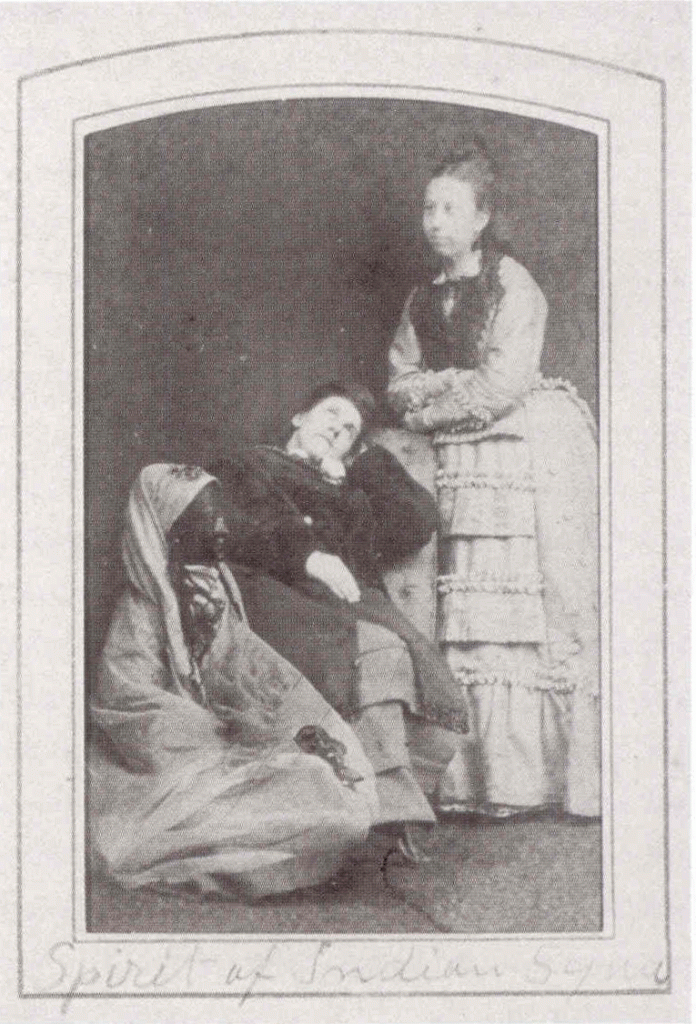
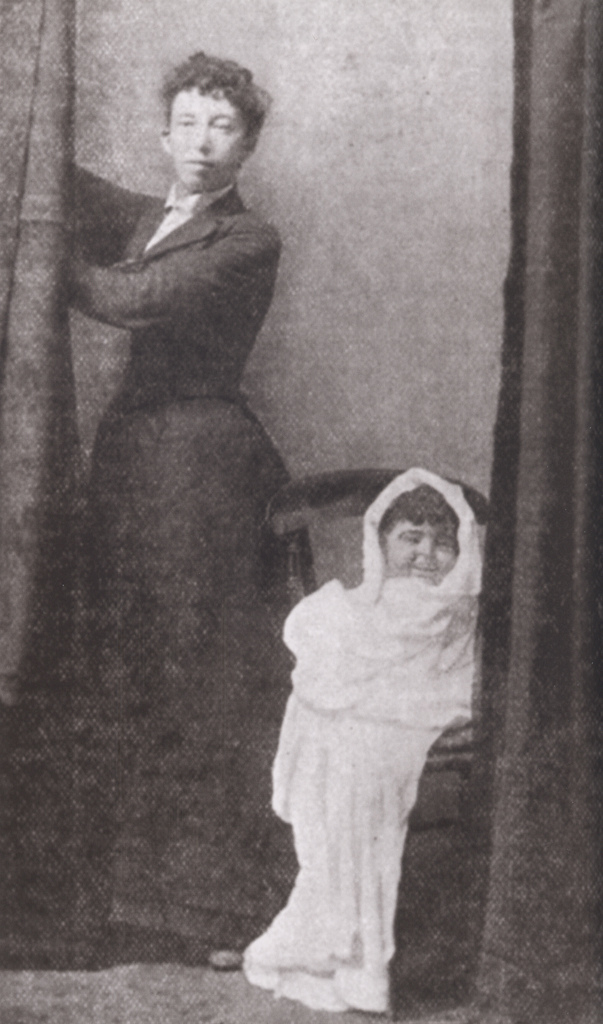
Catharine Elizabeth Wood, better known as Miss Wood or C.E. Wood, was a celebrated but somewhat controversial medium from Newcastle. She was the associate of Annie Fairlamb Mellon, whose career would face similar tribulations.17 In September 1882, Wood was invited to hold two séances at Catling’s new home at Lilian Villa, 2 Granville Street.
The first of two planned séances, at 8pm on Monday 11th September, started conventionally. Mr. and Mrs. Catling had invited 17 guests, including a reporter from the Peterborough Express. In near complete darkness, with just one dimmed paraffin lamp, Wood sat tied to an armchair inside the cabinet. One of her conditions was that, if a spirit were to manifest physically, no-one should approach or speak to them without her permission.
The group sang hymns and discussed Spiritualism with Miss Wood. The medium recited poetry that she said was written by a 13-year-old “Indian” girl called Pocha, or Pocka, short for Pocahontas. After about two hours, a small, ghostly figure materialised in the darkness. It was “Pocha.” The apparition played music boxes, spoke to the group, handed out sweets, and even kissed one of the women.
Suddenly, Charles Cade leapt from his seat and grabbed “Pocha.” The two scuffled and Cade fell into Wood’s chair, still holding the white figure. A man tried to undim the lamp but accidentally turned it off. When the light was eventually switched on again, it revealed Catharine in Cade’s arms. She was no longer wearing the black dress in which she had arrived but was covered in white muslin cloth. Several of the women guests tried to grab pieces of the cloth, but Wood reportedly tried to bite them.18
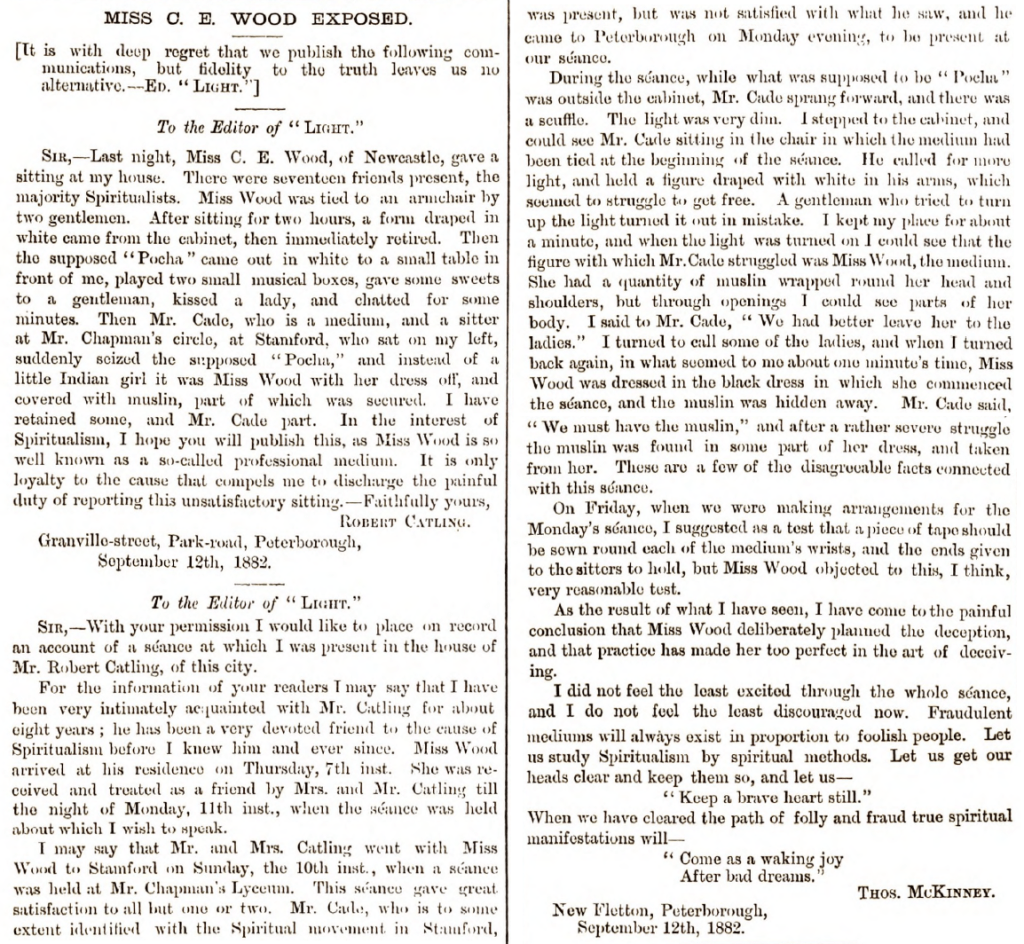
Robert Catling and Thomas McKinney wrote letters to a Spiritualist newspaper to give their accounts of the incident. Their words are worth reproducing in full:19
According to McKinney, ‘An evening or two before the seance I suggested to Miss Wood that, for the satisfaction of strangers, it would be well to have a piece of tape tied round each wrist, and the ends passed out to the sitters. She refused this test.
‘After a very careful consideration of what I have witnessed, I have come to the conclusion that Miss Wood deliberately planned the deception, and that she has had a great deal of practice in the art of deceiving. I am very sorry that I have been compelled to think so.’20
Miss Wood, in her defence, claimed to have been in a trance the whole time, only coming to her senses the following morning. An anonymous letter to The Medium and Daybreak disputed this claim:
‘As regards Miss Wood being entranced until five o’clock next morning, in my opinion and all present, it was a sham: her dexterity in getting her dress on, and concealing the muslin, her attempting to bite the ladies who were trying to procure the muslin, they only succeeded in getting part of it, and when they tried to put her boots on she doubled her feet up in order that they would not be got on, all proved the truth that she was not entranced. She is the most artful trickster I ever came across.’21
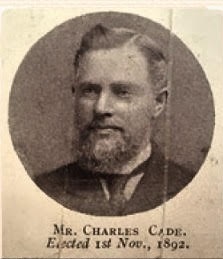
When Charles Cade gave his own account, he said, ‘At three o’clock in the morning she threw herself off the couch. I then scolded her for her stupidity, told her it was impossible to convince me that she was entranced, and asked her why she did not act in a more sensible manner. I then said, in a stern manner, “Get up and act properly.” She then got up, opened her eyes, and began to ask where the people were. At that moment Mrs. Catling came down. She at once fell back on the couch again, and feigned unconsciousness until five o’clock.’22
It seemed that Wood had been exposed as a fraud, but it was not the first time. In 1877, she was caught impersonating a spirit at Blackburn. One sitter, being fed a biscuit by “Pocks,” thought he discerned the medium kneeling in front of him, playing the part of the child. Like Cade, he had grabbed hold of her in the dark, but she fell to the floor. When two guests lit matches, Wood was seen lying there, wearing only her underwear. The séance recommenced and, speaking as “Pocks,” Wood said she had been taken over by an evil spirit who forced her to disrobe. No-one believed her. The party refused to pay for her services, and she signed a contract waiving any right to sue for the money.23
The incident at the Catling household caused heated debate on both sides of the pond, with ugly accusations going both ways. The Medium and Daybreak said they had received bundles of mail about the incident but refused to publish them. In their opinion, Miss Wood’s impostures had no bearing on Spiritualism itself and so were not within their remit, adding, ‘Miss Wood has been “exposed” more times than we know the number of, in public and private, to our knowledge sometimes innocently, at other times apparently less so.’24
Many people sprang to Wood’s defence. One correspondent from her home city of Newcastle said he had seen more evidence of her abilities than he could ever need. He even suggested that, if she were indeed caught as described, there was a chance she was put into that position by controlling spirits. Either way, mediums were under too much pressure to perform on every occasion, making such scenes inevitable.25
One writer, incensed at the way Wood had been treated, suggested that a kind of transmogrification had taken place:
‘Miss Wood goes to Peterboro to give a seance, she is lashed to a chair by “two gentlemen” (!!) she endures the ordeal for two long hours, when a form appears to the sitters draped in white. This form converses with the sitters, as the spirit of a Hindoo girl, goes around among them, gives sweetmeats to a gentleman and kisses a lady, when a man a professed medium, seizes that girl-like form and holds it. It resolves itself into the person of the medium, Miss Wood, who remains in an unconscious state while the men and women who were present try to secure the drapery that had enveloped the form of the Hindoo girl.’26
The most spirited defence came from the Philadelphia-based Mind and Matter journal, which accused the editor of The Medium and Daybreak of being a traitor to Spiritualism:
‘Many accounts have been published in the English Spiritual papers, of the remarkable and undoubted spirit materialization phenomena that have been occurring at the seances of Miss C. E. Wood, of Newcastle, England, under the most absolute test conditions. No one in that priest-ridden country could find any plausible reason for questioning the genuineness of the mediumship of Miss Wood, or of the spirit materializations that were positively known to take place at her seances. This was a state of things that the enemies of Spiritualism could not afford to let go on.’27
The author calls those trying to secure the muslin ‘Jezebels’ and claims that only part of it being secured proves that supernatural agency was involved.
‘We are convinced, from the information that has been given, and have not a doubt of it, of the entire innocence of Miss Wood, and that the dishonesty and untruthfulness of the affair is entirely with her accusers.’
In dismissing the affair, the editor of The Medium and Daybreak had called Miss Wood a ‘fallen one,’ to which the writer took issue: ‘We know not what ground J. Burns may have for comparing Miss Wood to a diseased strumpet, but we can hardly think he could have placed her and her accusers upon a lower plane of depravity.’
‘Too dishonest and mercenary to defend the cause he has fastened himself upon as a leech, Burns would drive the few mediums who are doing whatever is done to advance that case from the field, because a set of ignorant fools, who are ignorant (mainly because papers like The Medium and Daybreak, have been too mercenary and selfish to place the truth before them), seek to ruin those mediums. It is much easier and more profitable to turn in and help to crush and ruin thoroughly tested and demonstrated mediums, than it is to defend and right the wrongs done them, and hence Burns naturally pursues that disgraceful and suicidal course.’
‘Why is Miss Wood put on a level with a common prostitute, in what occurred at Peterborough? Shame! Shame!’28
Robert Catling and Thomas McKinney’s faith in Spiritualism remained unshaken. Catling signed a letter the following month calling for a ban on all séances held in complete darkness.29 McKinney said, ‘Fraudulent mediums will always exist in proportion to foolish people… When we have cleared the path of folly and fraud true spiritual manifestations will “Come as a waking joy/After bad dreams.”’30
Charles Cade, having once been described as a medium himself,31 became openly sceptical of the movement. Between 1882 and 1884, he gave a series of lectures about Wood’s exposure and demonstrated some of the techniques used by conjurers. He had retained some of the muslin with which Wood had draped herself and wrapped himself in it while re-enacting that night. One of these lectures was attended by a Mr. McKinney, presumably Thomas McKinney. He argued that ‘he did not think Spiritualism was fully exposed,’ and offered his personal testimony of some other events he thought could not be explained any other way.32
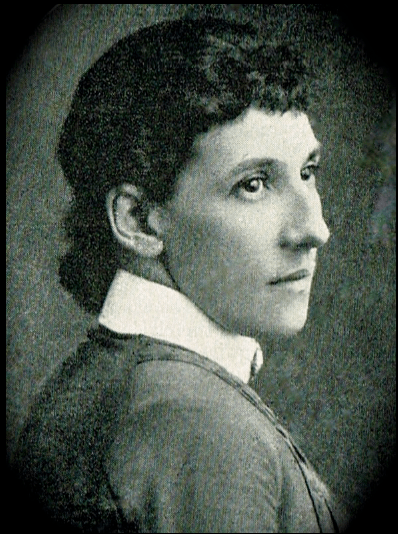
Wood never quite escaped the stigma of being a fraudulent medium. Even when she toured Australia, her reputation went before her. She submitted herself to numerous tests of her abilities, convincing some but not others.33 Less than two years later, she had passed away.
Wood died while on tour in Adelaide. She was most likely 32 years old, although some sources claim she was 26 or 30. The cause of death was given as typhoid fever.34 Bridget Bennett suggests that drink also played its part: ‘She was able to survive exposure, though eventually succumbed to alcohol just like Margaret and Kate Fox and other women mediums who found spiritualism could be a precarious way of earning a living.’35 I have not been able to substantiate this. In many ways, Wood remains an enigma, even in death.
Robert and Isabella Catling moved several times in later life, to Camberwell in London, Leire in Leicestershire, and Clacton-on-Sea in Essex. Robert died in 1927, aged 77 or 78. What happened to Isabella is unknown.
Despite a wave of medium-snatching in the 1870s and 1880s, Spiritualism continued to be popular until the 1920s, when it came under sustained attack from people like Harry Houdini, Harry Price, and Elijah Farrington. Books like Price’s Revelations of a Spirit Medium (1922) exposed to a wide audience the methods used by less scrupulous practitioners.
You can still find many Spiritualist churches today, but they have never regained the following they once had. Their practices have changed significantly. The days of physical manifestation are long-gone. It is not my intention to criticise those with Spiritualist beliefs today. I am sure they would like to distinguish themselves from the more dramatic events of the 19th century.
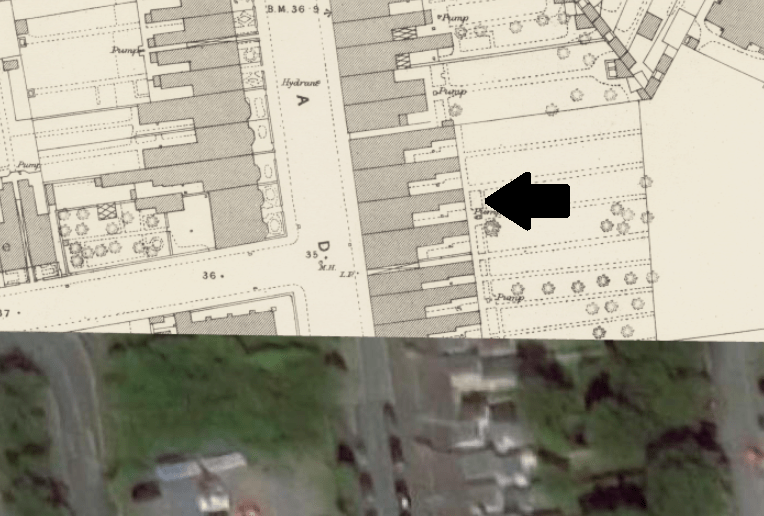
I would love to have included a photograph of the house on Granville Street, but it is sadly no longer there. Catling sold the house in 1895,36 after which it changed hands several times,37 finally being bought by Cambridgeshire County Council and becoming part of the King’s School site.
With the kind assistance of Trevor Elliott, the former deputy head of King’s, I was able to find the exact location of the house. Using some old maps from their collection, we realised it would have been in the rear car park of the school, where the electrical boxes now stand. Oddly enough, Trevor recalled teaching Latin classes in the house before it was demolished. He believes he is the last person alive to have taught lessons there. From Cromwell Road to Granville Street to Narrow Street (now Bridge Street), none of Robert Catling’s houses remain.

Those who would like to know more about Robert Catling, Charles Cade, and Thomas McKinney might be interested to find that they made headlines just a few years later, this time because they were part of the anti-vaccination movement. This episode deserves an article all its own, so I look forward to sharing Part 2 with you in the next issue.
Many thanks to Chris Bratt, Max Conn, Jane Craig-Tyler, Trevor Elliott, Keith Hansell, Karen Meadows, Christopher Monk, Julie Nicholson, David Stanbridge, The International Association for the Preservation of Spiritualist and Occult Periodicals, The King’s (The Cathedral) School, and Stamford & District Local History Society for assisting in my research.
- ‘Glimpses of the past No. 45’, Peterborough Standard, 14th December 1928, p. 8; Dotty McLeod and Harriet Heywood, ‘Cycling club celebrates its 150th anniversary’, BBC News, 29 June 2024, https://www.bbc.co.uk/news/articles/c2q0r0zxpl0o ↩︎
- ‘Cycles for sale and wanted’, Peterborough Express, 19th and 26th September 1894, p. 4 ↩︎
- ‘Bicycle Contest’, Peterborough Standard, 30th October 1875, p. 8; Peterborough Cycling Club centenary booklet (1974), p. 7, https://www.peterboroughcyclingclub.co.uk/club-history-1874-1974-peterborough-cycling-club-centenary/ ↩︎
- ‘At a Spiritualists’ séance’, Peterborough Advertiser, 14th February 1874, p. 4; ‘Spiritualism’, Peterborough Advertiser, 5th December 1874, p. 2 ↩︎
- ‘The Story of Our Church’, Peterborough Christian Spiritualist Church website (last updated 2022), https://www.pcschurch.co.uk/history ↩︎
- ‘Spiritualism’, Peterborough Standard, 17th January 1874, p. 6 ↩︎
- ‘Correspondence’, The Spiritualist and Journal of Psychological Science, vol. 5, no. 23 (119), 4th December 1874, p. 276 ↩︎
- John T. Markley, ‘Phrenology in the schoolroom’, The Medium and Daybreak, vol. 6, no. 260, 26th March 1875, p. 202-3 ↩︎
- The Medium and Daybreak, vol. 9, no. 456, 27th December 1878, p. 820; Thomas McKinney might also be the same ‘MacKinney’ of Peterborough who defended the movement at a lecture called ‘Spiritualism a Delusion’ at Oundle Town Hall in 1876: ‘Spiritualism’, Peterborough Standard, 19th February 1876, p. 8. ↩︎
- ‘Mr. Chapman of Peterborough’, The Medium and Daybreak, vol. 5, no. 242, 20th November 1874, p. 746; ‘A Peterborough Medium’, Peterborough Advertiser, 28th November 1874, p. 2 ↩︎
- “Anti-Humbug”, ‘A Night with the Stamford Spiritualists’, Peterborough Standard, 18th September 1880, p. 3; ‘Seances in the Provinces During the Week’, The Medium and Daybreak, vol. 11, no. 549, 8th October 1880, p. 652; ‘Our Contemporaries’, Light, no. 41, 15th October 1881, p. 331; ‘Stamford Liberalism v. Stamford Conservatism’, Stamford Mercury, 16th June 1882, p. 6; ‘Assembly of the “London Spiritualist Alliance”’, Light, vol. 11, no. 532, 14th March 1891, p. 122; ‘Stamford Town Council’, Stamford Mercury, 5th June 1891, p. 3.
Here is the original, uncorrected text:
‘Chapman seems to have moved to Stamford and built a small theatre called the Lyceum (or Progressive Lyceum), where séances were held for some years. Its exact location is uncertain, but it seems to have been in or around the recreation ground in Northfields, which was in the process of becoming the town’s first suburb. Chapman’s fame seems to have been short-lived, but there are worse fates than being forgotten.’
↩︎ - “Willie”, ‘Séance of Symbolical Pictures, &c’, The Medium and Daybreak, vol. 12, no. 574, 1st April 1881, p. 194-5 ↩︎
- Ibid. ↩︎
- Robert Catling, ‘Dr. Monck at Peterborough’, The Medium and Daybreak, vol. 6, no. 259, 19th March 1875, p. 187; John T. Markley, ‘A Seance in Peterborough’, The Spiritualist and Journal of Psychological Science, vol. 6, no. 12 (134), 19th March 1875, p. 141 ↩︎
- Marc Demarest, ‘Some Notes on the Life of Francis Ward Monck (1835-1896?)’, Chasing Down Emma, 1st January 2014, https://ehbritten.blogspot.com/2014/01/some-notes-on-life-of-francis-ward.html ↩︎
- “Omega”, ‘Spiritualism in the Midlands’, The Medium and Daybreak, vol. 13, no. 648, 1st September 1882, p. 556 ↩︎
- Kate Cherrell, ‘Annie Fairlamb Mellon: The Geordie Medium’, Burials & Beyond, 5th August 2020, https://burialsandbeyond.com/2020/08/05/annie-fairlamb-mellon-the-geordie-medium/comment-page-1/; T. Shekleton Henry, “Spookland!” A Record of Research and Experiment in a much-talked-of realm of mystery, with a Review and Criticism of the so-called spiritualistic phenomena of Spirit Manifestation, And Hints and Illustrations as to the possibility of artificially Producing the Same (1894, W. M. MacDarby and Co.) ↩︎
- ‘Miss C. E. Wood Exposed at Peterborough’, The Medium and Daybreak, vol. 13, no. 650, 15th September 1882, p. 583 ↩︎
- Robert Catling and Thomas McKinney, ‘Miss C. E. Wood Exposed’, Light, vol. 2, no. 89, 16th September 1882, p. 410. For another contemporary account, see: ‘Spiritualistic Exposure’, Stamford Mercury, 15th September 1882, p. 4.
For those unable to read from the image, here is the full text of Catling and McKinney’s letters:
MISS C. E. WOOD EXPOSED.
[It is with deep regret that we publish tho following communications, but fidelity to tho truth leaves us no alternative.—Ed. “Light.”]
To the Editor of “Light.”
Sir,—Last night, Miss C. E. Wood, of Newcastle, gave a sitting at my house. There were seventeen friends present, the majority Spiritualists. Miss Wood was tied to an armchair by two gentlemen. After sitting for two hours, a form draped in white came from the cabinet, then immediately retired. Then the supposed “Pocha” came out in white to a small table in front of me, played two small musical boxes, gave some sweets to a gentleman, kissed a lady, and chatted for some minutes. Then Mr. Cade, who is a medium, and a sitter at Mr. Chapman’s circle, at Stamford, who sat on my left, suddenly seized the supposed “Pocha,” and instead of a little Indian girl it was Miss Wood with her dress off, and covered with muslin, part of which was secured. I have retained some, and Mr. Cade part. In the interest of Spiritualism, I hope you will publish this, as Miss Wood is so well known as a so-called professional medium. It is only loyalty to the cause that compels me to discharge the painful duty of reporting this unsatisfactory sitting.—Faithfully yours,Robert Catling.Granville-street, Park-road, Peterborough,September 12th, 1882.
To the Editor of “Light.”
Sir,—With your permission I would like to place on record an account of a séance at which I was present in the house of Mr. Robert Catling, of this city.
For the information of your readers I may say that I have been very intimately acquainted with Mr. Catling for about eight years; he has been a very devoted friend to the cause of Spiritualism before I knew him and ever since. Miss Wood arrived at his residence on Thursday, 7th inst. She was received and treated as a friend by Mrs. and Mr. Catling till the night of Monday, 11th inst., when the séance was held about which I wish to speak.
I may say that Mr. and Mrs. Catling went with Miss Wood to Stamford on Sunday, the 10th inst., when a séance was held at Mr. Chapman’s Lyceum. This seance gave great satisfaction to all but one or two. Mr. Cade, who is to some extent, identified with the Spiritual movement, in Stamford, was present, but was not satisfied with what he saw, and he came to Peterborough on Monday evening, to be present at our séance.
During the séance, while what was supposed to be “Pocha” was outside the cabinet, Mr. Cade sprang forward, and there was a scuffle. The light was very dim. I stepped to the cabinet, and could see Mr. Cade sitting in the chair in which the medium had been tied at the beginning of the séance. He called for more light, and held a figure draped with white in his arms, which seemed to struggle to get free. A gentleman who tried to turn up the light turned it out in mistake. I kept my place for about a minute, and when the light was turned on I could see that the figure with which Mr. Cade struggled was Miss Wood, the medium. She had a quantity of muslin wrapped round her head and shoulders, but through openings I could see parts of her body. I said to Mr. Cade, “We had better leave her to the ladies.” I turned to call some of the ladies, and when I turned back again, in what seemed to me about one minute’s time, Miss Wood was dressed in the black dress in which she commenced the séance, and the muslin was hidden away. Mr. Cade said, “ We must have the muslin,” and after a rather severe struggle the muslin was found in some part of her dress, and taken from her. These are a few of the disagreeable facts connected with this séance.
On Friday, when we were making arrangements for the Monday’s séance, I suggested as a test that a piece of tape should be sewn round each of the medium’s wrists, and the ends given to the sitters to hold, but Miss Wood objected to this, I think, very reasonable test.
As the result of what I have seen, I have come to the painful conclusion that Miss Wood deliberately planned the deception, and that practice has made her too perfect in the art of deceiving.
I did not feel the least excited through the whole seance, and I do not feel the least discouraged now. Fraudulent mediums will always exist in proportion to foolish people. Let us study Spiritualism by spiritual methods. Let us get our heads clear and keep them so, and let us—
“ Keep a brave heart still.”
When we have cleared the path of folly and fraud true spiritual
manifestations will—
“Come as a waking joy
After bad dreams.”Thos. McKinney.New Fletton, Peterborough,September 12th, 1882.
↩︎ - ‘Miss C. E. Wood Exposed at Peterborough’, The Medium and Daybreak ↩︎
- Ibid. ↩︎
- Charles Cade, ‘Miss Wood at Peterborough’, Light, vol. 2, no. 93, 14th October 1882, p. 460 ↩︎
- ‘Miss Wood Caught Impersonating a Spirit’, The Medium and Daybreak, vol. 8, no. 385, 17th August 1877, p. 523-524; Paul J. Gaunt, ‘The Beginnings of Full Form Materialisations in England: Catherine (Kate) Elizabeth Wood 1854-1884 – Concluded’, Psypioneer, vol. 8, no. 2 (February 2012), p. 62-76 ↩︎
- James Burns, ‘The Peterborough Affair’, The Medium and Daybreak, vol. 13, no. 651, 22nd September 1882, p. 598 ↩︎
- J. Walton, ‘Satisfactory Materialization Experiments. Miss Wood, Medium’, The Medium and Daybreak, vol. 13, no. 653, 6th October 1882, p. 629-630 ↩︎
- ‘It looks like war’, Mind and Matter, vol. 4, no. 47, 14th October 1882, p. 5-6 ↩︎
- J.M. Roberts, ‘Bundyism in England’, Mind and Matter, vol. 4, no. 47, 14th October 1882, p. 4. As we have seen, the claim that no-one had expressed doubts about Miss Wood up that point was clearly false. There is also no reason to believe Catling or McKinney considered themselves to be ‘enemies of Spiritualism’ as they had been part of the movement for at least eight years at that point and retained their faith long after. ↩︎
- Ibid. ↩︎
- ‘Dark and Cabinet Seances for “Form Manifestations”’, The Psychological Review, vol. 5, no. 19 (October 1882), p. 351-366 ↩︎
- Robert Catling and Thomas McKinney, ‘Miss C. E. Wood Exposed’, Light ↩︎
- Ibid. ↩︎
- ‘Spiritualism’, Peterborough Standard, 19th January 1884, p. 8. See also: Stamford Mercury, 1st December 1882, p. 4. ↩︎
- Elisabeth Warwood goes into some detail about the last two years of Wood’s life: Elisabeth Warwood, ‘Catharine Elizabeth Wood (1852-1884): The Final Two Years’, Psypioneer, vol. 11, no. 2 (February 2015), p. 39-55. The people who would go on to found the influential Society for Psychical Research tested Wood’s abilities beginning in 1874, also detecting deception: Eleanor Sidgwick, ‘Results of a personal investigation into the physical phenomena of Spiritualism: with some critical remarks on the evidence for the genuineness of such phenomena’: Proceedings of the Society for Psychical Research, no. 4 (May 1886), p. 45-74; Adrian Parker and Elisabeth Warwood, ‘Revealing the Real Madame d’Esperance: An Historical and Psychological Investigation’, Journal of Scientific Exploration, vol. 30, no. 2 (2016), p. 233-66. ↩︎
- Paul J. Gaunt, ‘The Beginnings of Full Form Materialisations in England’ ↩︎
- Bridget Bennett, Transatlantic Spiritualism and Nineteenth-Century American Literature (2007, Springer), p. 48-9 ↩︎
- ‘For Sale’, Peterborough Express, 20th February and 14th March 1895, p. 4; ‘For Sale’, Peterborough Standard, 2nd and 9th March 1895, p. 3 ↩︎
- ‘Sales by Auction’, Peterborough Standard, 29th September and 6th October 1906, p. 4; ‘Sales by Auction’, Peterborough Standard, 20th August 1948, p. 3; ‘Sales by Auction’, Peterborough Standard, 27th August, 3rd and 10th September 1948, p. 3; ‘£3,050 for house on Broadway’, Peterborough Standard, 17th September 1948, p. 1 ↩︎




 Eccentric Orbits: Collected Writing from Tony Conn